Featured

On Sale Now – The Explosive Sequel – “Beyond the Rivers of Time”

Beyond the Rivers of Time: A Novel of Distant Worlds

Purchase Direct at the link below, or find it anywhere books are sold.

Buy Now

An alien city. A fractured timeline. A race to survive. Fans of Ender’s Game and classic Star Trek will love this smart, high-stakes sci-fi adventure.

A thoughtful, action-driven read for YA and crossover adult audiences who love mystery, technology, and deep questions of identity and survival.

When humanity’s first interstellar voyage ends in a cataclysmic explosion, the Sol System mourns the loss of the starship Katie and her crew; Captain Charles Bimmy and his wife, brilliant scientist Becca Kiel.

Thirteen light-years from Earth, on the surface of an alien planet, the truth is far more complex. The crew survived the blast, and is transformed into something extraordinary.

Discovering a pristine city untouched by time, maintained by hidden forces, Bimmy and Becca find themselves changed; physically enhanced, yet unsure what they’ve become. When a rescue mission finally reaches them, it triggers a chain of events that will uncover long-buried secrets, reignite old wars, and draw the attention of powerful forces from across space, and time.

As rival factions vie for control of interstellar travel, and the worlds it has revealed, Bimmy and his crew must navigate treacherous alliances, unravel the mystery of a lost civilization, and confront a future that may already be written.

From the vast desert of a distant world to the burning heart of a shattered empire, Beyond the Rivers of Time is a sweeping space opera of found family, technological transformation, and humanity’s place among the stars.

Now on sale everywhere including Barnes & NobleBookshop.org, and Amazon.com.

Featured

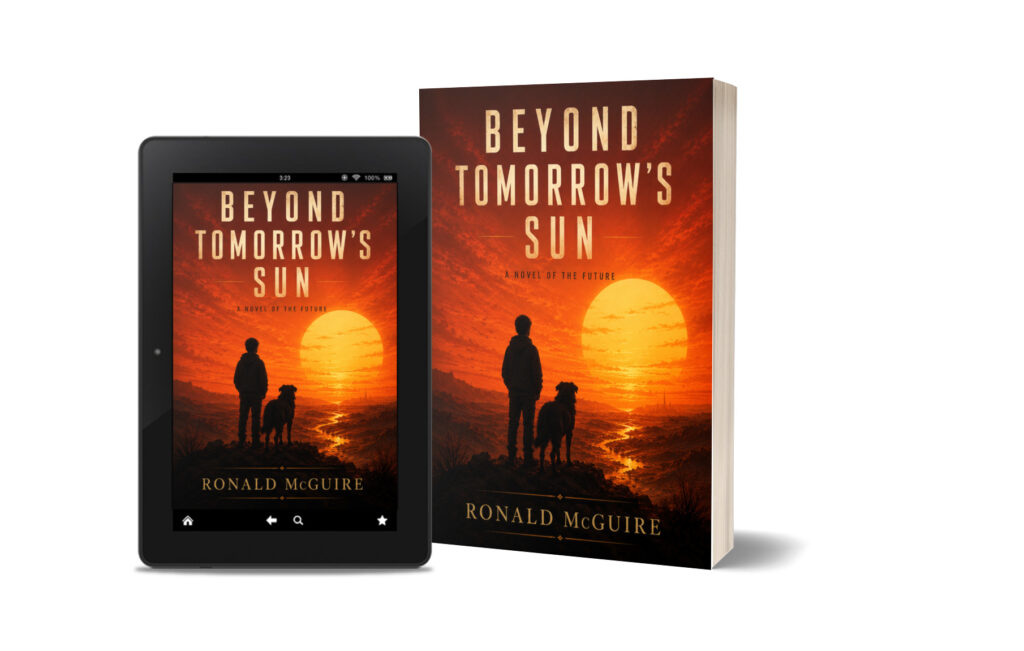
Beyond Tomorrow’s Sun – Now Available!

Now available, my Page Turner Award finalist “Beyond Tomorrow’s Sun” has arrived. And get ready for the sequel, “Beyond the River’s of Time,” arriving early 2025.

Available in ebook and paperback at Bookshop.org, Amazon, Barnes & Noble, Magers & Quinn, and anywhere else new books are sold! Use the button below to buy direct and save 15%. NOTE to resellers: this book is available through your normal wholesale supply chain.

Beyond Tomorrow’s Sun: A Novel of the Future
McGuire, Ronald
Buy Direct and Save 15%

A young boy flees a desperate situation and finds a new home, a new family and epic interplanetary adventure. Set in a post-war 24th century America, 13-year-old Charlie runs away from his abusive uncle, following an old road he hopes will lead him to the ocean. Along the way he’s joined by a lost dog, Katie, and fights for survival in the wastelands. When Charlie reaches the end of the road, he discovers the thriving and technologically advanced city of Arcadia, where he saves the life of head-strong Becca Kiel, after her illicit journey through a wormhole lands her in the middle of a busy street. Charlie settles into a new life, and his friendship with Becca grows, until their destinies become intertwined as they dream of finding a new home for humanity, somewhere among the stars.

Cover design by Gene Rayner

Start TRC Case for the DJI Osmo Mobile (7, 7P, 8) Review

My review of the Star TRC DJI Osmo 7, 7P, or 8 Gimbal Case. I’m building out a new video setup, one piece of gear at a time, and I’ll be posting reviews here, on social media,  and on my YouTube channel. I hope you’ll check it out.

Beyond the Rivers of Time – Cover Reveal

It’s finally here! The cover for “Beyond the Rivers of Time,” sequel to “Beyond Tomorrow’s Sun,” and a Page Turner Award Finalist in its own right.

The epic adventure of Charlie and Becca continues. They’re joined by some old friends, and new enemies, as they explore distant worlds, and expand their quest for a new home to galactic proportions.

Pre-orders will be available beginning May 1, on sale everywhere beginning June 1, 2025, including Barnes & NobleBookshop.org, and Amazon.com.

An interstellar spacecraft crashes on an alien world, where a mysterious force alters the crew’s sense of humanity, sending them on a quest for answers, and survival.

A journey of discovery, 13 lightyears across the galaxy in an untested starship, will forever alter the course of human history, in ways no one can predict. Unless, of course, they’re a member of the Temporal Guards.

Humanity’s first attempt at interstellar travel ended with a cataclysmic explosion. With no sign of the ship and crew for over a year, the people of the Sol System are left grieving the loss of Captain Charles Bimmy and his scientist wife, Becca Kiel. 

But on the Deimos Colony orbiting Mars, a young astrophysicist, Dex Farber, has discovered convincing evidence indicating the crew not only survived, but are now trapped at their destination, the planet Luyten b. 

A rescue mission is set in motion, and the stakes are nothing less than the fate of the known galaxy, and humanity’s place in it. 

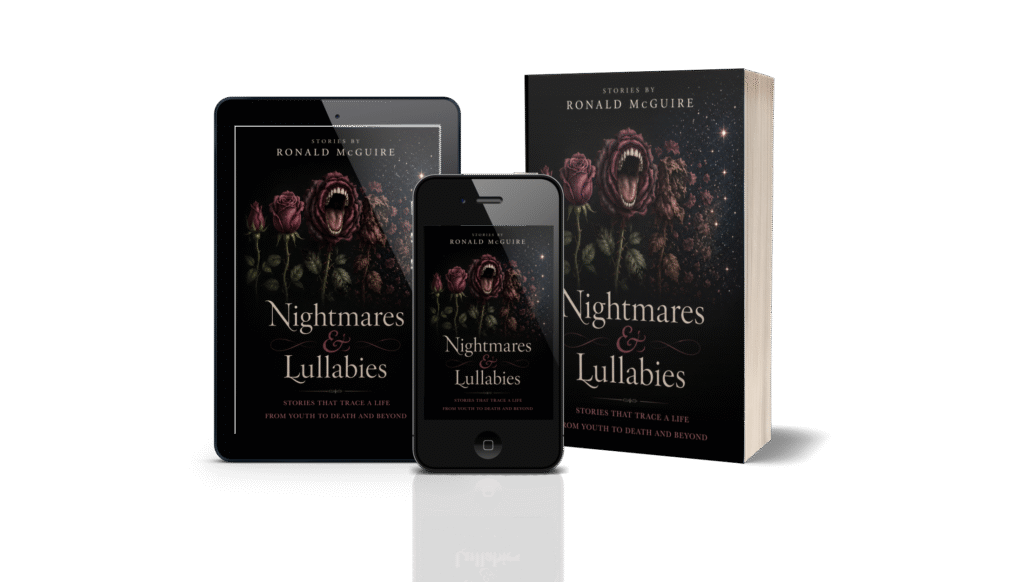
Nightmares & Lullabies, Now Available!

My first collection of LGBTQ short stories, “Nightmares and Lullabies,” is now available.

At times moving, mischievous, and reflective, much of the work is centered on the gay experience at varying life stages. In “Early Summer,” a boy’s first crush leads to the joy of reciprocity, while in “An Understanding,” bitterness, anger, and regret, fill the days of a man whose arrogance has cost him everything he didn’t know he needed, while “Lullaby” reveals a glimpse of the life after this one. This genre-spanning collection includes the award-winning literary fiction “Fitting In,” the sci-fi dystopia of “Farewell, Hollywood,” and the bizarre horror and dark humor of “A Time to Dance,” and “The Not-Zombies Apocalypse.” From the surreal to the sublime, the stories in Nightmares & Lullabies are fearless, unapologetic, and rife with moral ambiguity. 

Ebook and paperback are available at AmazonBarnes & NobleRakuten kobo, pretty much anywhere books are sold, even Walmart. Or use the button below to buy direct and save 15%. NOTE to resellers: this book is available through your normal wholesale supply chain. When searching for the book, please use ISBN: 9781965621035 for ebook and ISBN: 9781965621028 for paperback. Some sites will show it unavailable due to a change in distributor.

Nightmares & Lullabies: Stories by Ronald McGuire
McGuire, Ronald
Buy Direct and Save 15%
Cover design by Gene Rayner, Art by Martin Solìs

Stars

This is a short story – a mood piece – about music, love, and forgiveness, and the power all three of those have to transcend time and change lives. Published by the amazing Jerry Jazz Musician website.

I hope you enjoy “Stars.”

So You Want to Be a Writer? Part 1

[This was the first in a four part series of essays for The Dillydoun Review, sharing my experience to date in the business of writing.]

Writing is not easy, it seldom pays well, and it fills your inbox with rejection. In early 2020, because I’m a glutton for punishment, I decided to write full time. 

If I knew then what I know now I would have made the same choice, but with a better strategy.

Because writing is also emotionally rewarding, intellectually stimulating, and can provide a good living for those who persist and hone their craft. As for rejection, it’s like table stakes in a poker game. If you can’t manage the baseline bet, you should sit out the game.

With that said, I am no expert. I did write for a major news outlet years ago, but that was a side job to my real job. Since last year, I’ve completed three novels, a book of poetry, a script for a TV pilot, and have a growing collection of short stories. 

In my first year I made every mistake a rookie writer can make, and it’s possible I invented some new ones. The last six months have gone much better.

I’m not a rookie anymore.

What do I have to show for all this you ask? Good question. 

My first script was a finalist in a TV Pilot competition, my self-published novel (under a pen name) was a finalist in another competition and cracked the Top 100 in its genre on Amazon (#98 briefly), and I’ve had several short stories accepted for publication. I have one novel in the hands of a publisher right now, another one just completed, and I have begun querying agents.

So far I’ve made exactly zero dollars.

The Big Payoff for me is experience

I learn best from hands-on experience. Now I’m on this journey and I’d like to share some of what I’ve learned so far.

Let’s start with the most basic – Do The Work. 

It sounds simple, but many aspiring writers never write, and for active writers, writing is haphazard and filled with distractions.

I spent years dreaming of being a novelist, and I didn’t write a single word toward my goal, mostly out of fear and self-doubt.

Your dream of being a writer won’t materialize if you don’t sit down, put your fingers on the keyboard, and type. Hemingway wrote his first drafts in pencil, so that works too. 

As new writers, the odds are already against us in this business. But there are ways we can start to tilt things in our favor.

I’ve found the three most important things for me are having a dedicated space to work, blocking out distractions, and setting a writing a schedule (and sticking to it). 

I work in the afternoon, six hours per day minimum, on average.

This includes research, querying agents, or submitting to publishers, contests and literary magazines. Mornings are for strong coffee, light reading, and walking the dog. In the evening, I do more research and a lot of brainstorming.

Yet I still struggle.

My schedule was recently obliterated by a piece of mail. Its contents presented a frustrating problem, but not an urgent one.

I spent ninety minutes of my afternoon dealing with it. 

Then I spent the rest of the day trying to refocus on writing. I got next to nothing done. It felt awful.

I didn’t properly prioritize my time and I paid for it with a lost afternoon. 

If I’m to have any hope of succeeded as a writer I have to learn to be selfish with my time, my space, my priorities, and my writing.

Because a loss of focus can cost even more time by allowing loads of errors to sneak into my work.

The less focused I am, the more likely I am to make mistakes I will fail to find and fix later.

The most insidious of these are typos. I am a self-taught typist, so I make a lot of typos.

For the record, spellcheck is not your friend and auto-correct is your declared enemy.

Spellcheck won’t tell you when you’ve typed “form” instead of “from” and it won’t tell you when auto-correct changed a mistyped “decided” to a correctly spelled, but wrong, “denied.” 

These tools are unreliable. They are often a hinderance. Plus, I tend to read right through typos and incorrect words, my mind filling in where my eyes refuse to see. 

I’m not saying, ‘don’t use them,’ I’m saying, ‘don’t trust them.’

I learned this the hard way when I wrote my first novel and decided to self-publish. I ran spellcheck and grammar check, fixed what was found, and sent the manuscript off to The Land of E-Book Publishing. 

When I loaded the ebook into my reader, I discovered it was filled with typos. I stopped counting at 47, across 42 chapters. One was in the opening paragraph. It wouldn’t have mattered if no one had downloaded the book. But they had, and I was embarrassed.   

Don’t trust automated tools, ever. 

Reread, reread, then reread some more. If you have someone in your life to proofread your work, or can afford to pay someone, consider yourself lucky. 

My solution is to reformat my text every time I read it. 

Change the font, the spacing, the borders, or even print the work if it’s not too long. If it’s a novel, I export it as an EPUB and read it on my favorite device. Think of it like driving down a bumpy road, then driving down the same road after it’s been repaved. Same road, different experience.

When I do this, I’m more likely to catch my errors and correct them before anyone else sees my work. It’s not a perfect system, but I’ve gotten good results from it.

In the end, writing is editing and editing is writing. I allow myself one exception to this rule. I try to avoid extensive editing while writing a first draft, whether it’s a novel or flash fiction, or anything in between. I like to capture my thoughts, finish the story, and clean up the words later.

Whatever I write, I expect to edit and revise until the work is polished. 

Here’s another useful tip: take some time between each pass. A day, a week, a month, you’ll figure out over time what length of break works for you.

Work on something else, read a book, improve your third-person bio, or research publishers, agents, journals, and competitions. Create some space to let your mind forget some of what you just wrote, then come back to it and edit with fresh eyes. 

Since you’ve read this far, I’ll leave you with a final thought. 

Don’t believe everything you read about writing. 

People like to Tweet quotes by famous writers, and Hemingway’s missives are no exception. The attributions are often wrong, or the words taken out of context. 

Hemingway is often quoted as saying, “Write drunk, edit sober.” 

I’d argue that’s objectively bad advice. 

According to Katherine Firth, Hemingway never said it. What he wrote in A Moveable Feast was: 

‘…my training was never to drink after dinner nor before I wrote nor while I was writing’ (p.61).

You can see the difference. 

The internet, and book stores, are loaded with advice for writers and a lot of it is good. But even the good advice won’t always be a good fit for you, and the bad advice can send you on some costly detours. Consider the source, take what works for you, leave the rest. 

I said I was no expert, but after 18 months of full time writing and research, I know where to find a few experts. 

Below are links to some websites I’ve found useful. If you’ve been writing for a while you know them already. If not, they make terrific companions for your writing journey. 

To sum it all up, work hard, be selfish with your time and attention, write-edit-repeat, take advantage of the help that’s out there, trust yourself, and learn from your mistakes. 

You got this.

Writer’s Digest: workshops, free downloads, how-to articles, competitions, you name it, they’ve got it, and most of it is free.  https://www.writersdigest.com

Winning Writers: one of the Writer’s Digest 101 Best Websites for Writers, they’ve got a focus on competitions and a massive list of links to great resources for writers, everything from advice, to literary forums, to ways to spot scams targeting writers. https://winningwriters.com

Alliance of Independent Authors: This should be your first stop if you’re considering self-publishing. There’s a LOT here, just like the two websites above, but one of the most useful things you’ll find is their ‘Best Self-Publishing Services’ list. If you read nothing else before you self-publish, review this list. https://selfpublishingadvice.org/best-self-publishing-services/

Lit Rejections: A site with stories, quotes and a blog about literary rejection, it also has some great interviews as well as information about literary agencies. If none of that sounds useful, at least visit and take a look at the collage of book covers from best sellers that were initially rejected. It’s eye opening. http://www.litrejections.com 

Authors Publish Magazine: Everything is free on this site and their email newsletter is filled with great information, but not overloaded. They research publishers and provide links to one that are open for submission, with a healthy does of paying markets. https://authorspublish.com

Why the Golden Girls Make Me Sick

“The Golden Girls” ran for seven years on NBC, a whopping 180 episodes in total. By any standards, that’s an impressive run. The star power of the cast was undeniable. Bea Arthur, Betty White, Rue McClanahan, and Estelle Getty delivered adult but family-friendly comedy, occasionally with a touch of drama to mix things up. The show’s staying power is impressive, its reruns are still available on streaming services and on demand via Hulu.

And to this day I cannot watch an episode without feeling a near overwhelming desire to vomit. This condition has improved over the years, but beginning in late 1991, a few years before the show ended, I could not so much as hear the show’s opening theme music without violent gastric distress. 

In 1991 I had cancer. Bad enough on its own, but add in a hospital wing being actively remodeled and a wall-mounted TV that got exactly one channel (NBC), the unfortunate timing of my chemotherapy, and the heavy rotation of  “The Golden Girls” reruns in the afternoon, and you’ve got yourself a witches brew, a confluence of ingredients ready made to create lasting associations.

I was in my late twenties and cancer took a great deal from me – mountains of money I didn’t have, a year of my life, some body parts, several friends, and “The Golden Girls.” The financial impact of cancer and the year of illness and recovery, these were temporary impacts compared to the Golden Girls-adjacent nausea. The body parts (I’ll spare you the gory details) while permanent losses, were manageable and sustainable losses, necessary for my survival.

The friends who walked away because they couldn’t handle the fact I might die or because, in at least one case, they thought I had AIDS, these too were sustainable losses – other friends rose to the occasion and remained steadfast during my illness and beyond.

But cancer has destroyed my enjoyment of “The Golden Girls.” My inpatient chemo was perfectly timed to run through the lunch hour. A nurse would hook up the IV bag, dial up the dose, then head off for their lunch break, a set-it-and-forget-it process, interrupted by the arrival of my hospital lunch. The quality of my meals, and I’m just being honest here, was rarely good on the way down and did not improve on the way up. 

But I had to eat and couldn’t always count on a visitor to bring me my favorite “I’m too sick to eat” meal of a baked potato and Frosty from Wendy’s. It was a struggle that dropped my weight from an unhealthy 275 pounds down to an even unhealthier 175. Although, on the upside, I had a 34 waist again for the first time since high school and could once again fit into my old American-made Levi’s. Nevertheless, it is not a weight loss strategy I can recommend.

There I would be, stuck in my hospital bed, a remote control for the TV that had two big and noisy buttons, On and Off, because there were no channels to change, and a few hours after starting my chemo both the nausea and the Golden Girls would arrive. “Thank You for Being a Friend” became the theme music for both the TV series and my episodes of retching. 

One might ask, “Why not turn the TV off?” and I would answer because I was stuck in a hospital bed, unable to sit up to read and desperate for any distraction that would help the time pass and simultaneously drown out the sounds of construction reverberating through the walls and floors. Also, the association between the sitcom and the sickness didn’t become apparent to me until the first time I watched the show at home after my treatment was complete and I was on my way to recovery.

I remember with absolute clarity the first time this complex relationship made itself manifest. It was one month after my last hospital stay. I was at home, alone, making dinner. I turned the TV on and by coincidence it was the top of the hour and “The Golden Girls” theme started playing. I was in the kitchen, the TV was on in living room – I couldn’t see the screen. Within seconds, I was making a beeline for the bathroom. Once I’d ejected everything I’d manage to eat that day, I entered the living room and plunked myself down on the sofa.

And I felt worse. Much worse. I decided to turn off the TV and put aside the meal I was making. The moment I shut off the television I started to feel better. Soon after I felt like I could get up, make dinner and go for a walk. Without thinking about it, I turned the TV back on and within seconds of Bea Arthur and Rue McClanahan exchanging a couple of snarky lines, I was ill again. 

Shut the TV off, and I felt better. That’s when I knew, “The Golden Girls” makes me sick. I know the title of this essay does not use proper grammar. Proper would be to say “The Golden Girls Makes Me Sick” because we’re talking about a singular TV series, but I like my title the way it is, there’s a better flow to it. At any rate, there’s one positive to this, which is the original Andrew Gold version of “Thank You for Being a Friend” is not now, nor has it ever been, a part of my medical oddity.

I’ve never been a big fan of the song, but it’s also never made me puke. I’ll put that in the plus column. Regarding “The Golden Girls,” as part of the writing of this essay I started an episode on YouTube, to see if the connection was still there. Sadly, it is safe to say, “The Golden Girls” still makes me sick.

In the grand scheme of things this problem is small and unimportant. But it’s an unusual remnant of a long-ago period of my life, one that reminds me more than anything else that I survived cancer and have now lived more years since I was diagnosed than I had lived before I fell ill. That’s at the very top of my plus column. You might say I’m durable, like a beloved sitcom, albeit not nearly as funny and hopefully never as nauseating.

One final note. After I recovered I spoke with a lawyer. I had been misdiagnosed by an ER doc who refused to listen to my symptoms and wrote my condition up as “stress induced gastritis.” He gave me a shot and sent me on my way. A few months later, the cancer had spread into my lungs and was making a forced march toward my brain. The lawyer told me, and I’m not sure he was right about this, but he told me I didn’t have a case for medical malpractice because I hadn’t suffer any permanent harm. I could debate this on any number of points, but from my current perspective, I’d say losing out on what was arguably one of the greatest sitcoms of all time represents a significant loss. There’s also that bit about the money and the body parts, but like I said, those were survivable. This Golden Girls issue is not going away.

So You Want to Be a Writer? Part 2

[My second essay for The Dillydoun Review – it’s about a 5 minute read for anyone interested in the business of writing and publishing (primarily fiction).]

You’ve done the work, you’ve written and re-written your story or manuscript multiple times, and you’re ready to submit your work to a publisher or agent. 

But how do you know your work is ready?

It can be difficult for a writer to turn a critical eye to their own work. It’s easy to overlook flaws or mistakes when you’re the one who created them. 

I’m talking about things like word choice, grammar, plot holes and dialogue. Do you have textual crutches you fall back on when you write, easy phrases you don’t realize you’re using? Are there phrases or words you repeat throughout your manuscript which, while they seem fine to you, might drive your readers crazy?

There are limited strategies for sussing out these sorts of problems, and like most things in a creative endeavor they can be highly subjective. 

Honest critical feedback is key to improving a story or manuscript, and to improving writing skills overall. Unfortunately, while honest feedback is your best friend, your best friend probably won’t give you any.

So how as writers do we critique and edit our own work, or find someone else to do it? 

I’ve adopted three strategies for addressing this problem. 

First, my go-to process was created by Samantha “Sam” R. Glas on her exceptional blog “Writing Like a Boss.” 

Sam has condensed a masterclass into a single post with “10 Warning Signs of Amateurish Writing & How to Fix Them.” 

Number 7, “Unnecessary Word Choice,” includes a list (from Writers Write) of filler words you can cut from your manuscript, words you and your readers will never miss. 

This may seem elementary, but the first time I used #7 to review a draft of a new novel, I found I’d used the word “just” over 400 times. It’s excessive, even for a sci-fi epic clocking in at 110k words.

400 edits because of one word. There were more I had to remediate, like “now” and “sort of.” It took a while, but it was worth it. I learned from it, and I now perform this “checklist” review for all of my work. It’s objective, simple, and effective. 

It has enabled me to approach my work in a new way and I’m finding fewer issues over time as I learn to check my bad habits while I’m writing.

But this won’t help with things like plot holes, ineffective dialogue, or other problems related to your story or writing style. 

For that, you need a human, which could be a costly endeavor but doesn’t have to be. 

This is where a manuscript swap, my second strategy, comes in handy.

The best thing I ever did with my first sci-fi novel was to share it with a fellow writer.

We exchanged manuscripts, then sent each other feedback. He called out critical problems I’d overlooked, and I was able to fix them with a series of edits, the removal of a chapter, and a change in sequence for a few other chapters. 

Seek out fellow writers and give this a try. You may not agree with the feedback you receive, but at least you’re getting feedback, and all it costs is time. 

Speaking of cost, this need for critical feedback has created business opportunities within the publishing industry, some of which are legitimate, some of which are not. 

I’m not going try to list all of the illegitimate businesses in the industry. Winning Writers has put together an awesome resource for this purpose, and I urge you to review it before you spend money on anything writing related. Writing communities on social media can be a good resource, but always consider the source. 

One special piece of advice for novelists: Be wary of vanity presses masquerading as publishers. There’s nothing wrong with self-publishing, but some businesses exist for the sole purpose of fleecing writers. Be sure to check out “The Best Self-Publishing Services and the Worst: Rated” created by The Alliance of Independent Authors. Combined with the information from Winning Writers, this can save you money, time, and a lot grief.

If you’re ready to pay for author services, pay yourself first by leveraging the existing research. 

If you’re not there yet, consider paying reading fees instead. 

What are reading fees and why should I pay them?

Great question, and it’s the third method I use to improve my writing. 

Th exception here is novels. Never pay a reading fee, an edit fee, or any other service fee associated with publishing your book to someone claiming to be a publisher or agent. I mean it, never. Don’t do it. Save your money and spend it on a legitimate editorial services provider whose purpose is to help improve your book before you submit it to a publisher or agent. (NOTE: Some publishers offer editorial services, but they make it clear these services are not part of the submission/acceptance process.)

For everything else, a reading fee, for those who don’t know, is exactly what it says, a fee charged in exchange for reading your work.

Let’s say you’ve written a short story and you’ve made all the revisions you think it needs. You find a literary journal you like and you click the “Submit” button. You’re re-directed to a submission management platform, like Submittable, and prompted to set up an account and possibly provide a credit card to cover submission fees. 

This is totally legit, nothing wrong here. There are several platforms used by literary journals and book publishers to manage submissions and contest entries. Submittable is a popular one, and most of the submission opportunities (not all) require a fee or request a donation.

This is where you want to proceed with caution. The questions I always ask are:

 – What will I get in return for this fee?

 – Is this the right publisher for my work? 

 – How many times has this publisher rejected my work previously?

I’ve submitted numerous stories this way, but I’ve also submitted work via publisher websites and email at no cost. In the end, if you’re not comfortable with a submission process, the easy response is don’t do it.

I’m fine to pay reading fees, especially when the fee comes with an expedited response, say 24 hours, or it’s an entry fee for a writing competition, or, and this is the best, the fee includes an editorial critique of my submission. For me, this is a low-cost, high impact way to hone my skills. 

If you can afford reading fees, look for publishers who offer detailed feedback when you submit your work. It’s a fast way to get a measure of your writing from a neutral party. Some of these fees are as low as $5, and some range to $25 or higher. If a fee seems high, check out the masthead of the journal. You might find the fee is worth it to get insights from an experienced and talented editor. 

But take note, paying for feedback should never guarantee acceptance, and paying for an expedited response might speed up rejection. Always manage your expectations. 

Also, make sure your work is a match for the publisher by reading what they’ve already published. Otherwise, you may be wasting their time and your money. 

In some cases, a rejection letter will come with a note encouraging a writer to submit again in the future. In one case, an editor rejected my story because she didn’t connect with it, but asked me to submit something else if I had anything ready. I did, and the second story was accepted. It’s all part of the process. 

However, if you’ve been rejected multiple times by the same publisher, you should consider moving on, at least for a time. You’re not connecting with the reader and your money is better spent elsewhere. This isn’t terrible. I was rejected three times by one literary magazine, and each rejection came with feedback. I used their feedback to improve the stories and the revised versions were accepted for publication elsewhere. 

To sum it up, I use three methods to gain a more critical view of my writing. First, I take a “checklist” approach to find and fix flaws. It creates objective space between me and my writing. Second, a manuscript swap. It’s a quid pro quo that works. Finally, feedback in exchange for reading fees. This is another win-win. I receive actionable feedback and the editor/publisher can keep the lights on and get a cup of coffee. 

Above all remember, no matter what anyone says about your work (good or bad), take a deep breath, accept it as part of the learning process, then forge on. 

Footnote for scriptwriters: Coverfly.com has a ton of scriptwriting competitions, most of which provide exceptional “coverage” (feedback) for an additional fee. These are expensive, so make sure your work is ready. They also host prose competitions for published and unpublished novels. 

So You Want to Be a Writer? Part 3

[My third essay for The Dillydoun Review, in which I make the case that writing is the journey and publication is the (first) destination.]

Writing is the First Step

So you want to be a writer, and the starting point seems obvious, write something! Therein lies the problem. Writing, creating, storytelling, that is the beginning of the journey, not the destination. The next step is getting published, and as hard as producing good work can be, getting it in front of readers (other than friends and family) can be the most difficult step to take. 

Let’s say you’ve done the work, you’ve refined your novel, you’ve even got objective feedback and some editorial guidance. Now what? Find an agent or a publisher or go the self-publish route? There’s a lot to unpack related to those decisions and processes, so I’m going to save that for my next essay. 

In this essay I’m going to focus on the business of getting your short work published digitally, in print, or both. Because you can go big and swing for the fences with your first novel if that works for you, but there are rewards to be reaped when you go small and submit your short stories, creative non-fiction and essays for publication. 

A quick search of the internet will turn up thousands of places to submit your work, including literary journals (online and print), writing contests, publishers (particularly anthologies), and several blogging/self-publishing platforms (e.g., Medium). The latter of these offer an opportunity to build and monetize an audience in a ways that didn’t exist before the internet. 

Before I dive into the more traditional offerings from this short list, I want to caution new writers. If you choose to post your work on a blog (even your own), or on sites like Medium or Wattpad, be aware that the overwhelming majority of literary journals, writing contests, and publishers consider anything published to any digital platform to be previously published work. This means either they will not consider the work for their platform/publication our it will be treated as a reprint, which at a minimum means any pay rate for the work will be lower than that for previously unpublished work. 

I have a WordPress site and I publish almost nothing there. I post links to my published work, which helps both my site and the publishing website. Right now my site generates about 2000 page views per day, which means several hundred people every day have the potential to discover new platforms where my work exists. Is it breaking any records? No, but if a literary journal publishes your work it’s in everyone’s best interest if you direct readers to that journal. The goal, as a new writer, is to get published and connect with readers. I recommend that you consider yourself in a symbiotic relationship with any publisher that gives your work a platform. 

With all that said, let’s talk about my three favorite places to submit work, and why. 

First and foremost, I love literary journals. I said there were thousands, but this is an understatement. There are online and print journals to match any and every taste and genre. Some are run by large well-funded teams affiliated with a university, others are side projects by young writers, some still in high school, and still others are the result of dedicated writers and editors who are passionate about the written word and give their heart and soul (as well as time and money) to an effort that might never generate revenue. 

One of the great things about submitting your work to a journal, whether online, print, or both, is that quite often you will receive editorial feedback on your submission. You may pay a reading fee to get that feedback, but as I said in my previous essay, this is a legitimate and useful tradeoff, a win-win situation. 

Keep in mind that most literary journals have limited resources and it takes time for submissions to go through the review process. Patience when submitting your work isn’t everything, it’s the only thing. If you’re not comfortable waiting, perhaps months, to find out if your work has been accepted, then you’re a good candidate for additional fees. In other words, if you want an expedited response, there are quite a few journals that will give you one for a price. To me this is fair, but keep in mind you are likely one of many writers who have submitted and paid a fee for a fast turnaround. The fee guarantees nothing beyond the response time – your odds of acceptance don’t go up, and might even go down due to the speed of the reply. Spend your money wisely. 

It’s a good idea to have multiple active submissions at any given moment, even if you’ve only produced one piece of work you feel is ready for submission. I personally do not like simultaneous submissions (submission of the same work to multiple journals). Yes, it is a numbers game to some extent and you need to write, submit, repeat. But as good as it feels to get a “yes” from one journal, if you’ve submitted to multiple journals you’ll have to withdraw your work from consideration from all of them. This is not fun, and while most journals accept work that has been submitted elsewhere, having a piece of work withdrawn is no fun for them either. 

My strategy: write, write, and write some more. When I’m not writing, I’m editing. When I think a piece is ready, I find a match (if I haven’t already) and submit. Then move on. Once you submit, it’s out of your hands so you might as well start something new. 

Because you never know when an opportunity is going to pop up, a call for submissions or a contest, that is a good match for your work. 

Writing contests are second on my list of favorite places to submit my work. Second because they tend to have a long run-up before even a short list is announced. I submitted two stories to a competition and by the time the winners were announced I had revised both stories several times and they were accepted for publication at two different journals. This is where my simultaneous submission rule breaks down. I’d rather withdraw from a competition if my work is accepted for publication than miss out on a chance to get published. To each their own on this point. 

Whether you win a competition, make the short list, or are rejected outright, there’s a lot of value in the process for new writers. At the least, you’ll see where you stand against other writers by reading the work of those who place in the competition. In some cases, your submission will garner critical feedback. Such a competition may have a higher entry fee, but in many cases it’s worth it. Just be clear on the vetting and feedback process before you pay your entry fees. As with anything, not every competition is worth the price. Of course, there’s always the chance your work will win the top prize. If this happens, make sure you shout it from the highest mountain top because you deserve the recognition, as does the competition. For lists of sites that can guide you to excellent writing competitions, check out the links in my first essay in this series. 

Finally, let’s talk about publishers. In this case I’m referring to book publishers who also publish anthologies of short work. An example of this would be Ab Terra, the sci-fi imprint of Brain Mill Press. While Ab Terra’s focus is on publishing novels, they also produce an annual sci-fi anthology. As with most publishers, submissions for these publications are usually open for a brief time once per year (more often for more frequently published anthologies). This is where preparation and patience are critical. Make sure your work is ready because there are no do-overs, and be certain you are a good fit for the publication because it could be months before you learn whether or not your work is accepted. 

The beauty of submitting your work to a publisher for an anthology like this is that the publication will be available in print, and if your piece is accepted, there’s nothing quite like holding a book and opening it to the page where your short story or essay lives. I just ordered two copies of the “Queer as Hell” anthology from Haunted MTL to give away because I honestly can’t wait to crack open the cover and see my story in print. This may not be special to everyone, but to me it’s the first time one of my short stories will appear in print, and in the end, getting published is, for me, the point. Getting published in a print anthology? That’s icing on the cake, and who doesn’t love a little icing now and again?

Just remember, like I said, it is a numbers game. If your work is solid and you know it’s ready, submit it and get back to writing. The more your write, the more you can submit, and in so doing, shift the odds a little more in your favor. Yes, you’ll have to deal with more rejection, but if you’re not ready for rejection, you’re not ready to submit. 

But if you’re truly ready, rejection will only make you stronger. Keep writing, keep reading, forge on. You got this.

TIP: If you’re submitting your work, you need a third-person bio. If you don’t know what that is, or how to write one, check out this great set of tips from the folks at Coverfly. (https://www.coverfly.com/5-tips-for-crafting-your-perfect-writer-bio/) Note that these tips are geared toward screenwriters, but they are still useful in helping any writer hone their “pitch.”